
Latest Products




Contact Us
- 201 Building A, Huashenghui Block, Xixiang Street, Bao'an District, Shenzhen City, Guangdong, China
- annie@visions-plus.com
- +8613760160092
Why Choose Us
Technology Innovation
The company has a strong technical research and development team that continues to innovate in its areas of specialization, introducing products or solutions that are competitive in the market. Technological innovation is the key to sustained growth, and choosing such a company means enjoying access to cutting-edge technical services and product support.
Experienced in the Industry
As a technology company with a certain influence in Shenzhen and even nationwide, Wearnes Technology has already accumulated rich project implementation experience and successful cases in many industries. This experience helps the company to more accurately grasp customer needs and provide tailored solutions, thus improving project success and customer satisfaction.
Quality Service
Quality service is the key to win customers' trust. Wearnes Technology has won the recognition and praise of our customers with its efficient, professional and caring services. This good reputation not only reflects the comprehensive strength of the company, but also provides new customers with the confidence and security of choosing the company.
The Concept of Cooperation and Win-Win
Upholding the business philosophy of openness, cooperation and win-win, the company actively establishes close cooperative relationships with enterprises upstream and downstream of the industrial chain, scientific research institutions and universities. This kind of cooperation not only helps enterprises to broaden market channels and enhance brand influence, but also can jointly promote the progress and development of the industry.
What is Ronchi Rulingss
Ronchi Rulings are usually made of a glass substrate with a grille formed by a metallic chrome coating on top. The width of the opaque lines is approximately 1/2 the line spacing, and this structure causes light to diffract and interfere as it passes through the lines.
 High Precision Ronchi Rulings
The grid calibration is suitable for comparator, length measuring machine, universal tool
Add to Inquiry Precision Ronchi Ruling Glass Slides
Ronchi ruling test target is a precise calibrating tool testing resolution, contrast, distortion,
Add to Inquiry Precision Ronchi Rulings On Opal Glass
Ronchi ruling,we also call it Ronchi grating or Ronchi mask.. Consist of a square wave optic with
Add to Inquiry Ronchi Mask
Ronchi rulings are bar and space square wave targets,consist of dark, parallel bars with widths
Add to Inquiry
• Simple and easy inspection method: The Rancic test is a widely used qualitative inspection method, especially for the inspection of optical surfaces of large aperture astronomical instruments. This method is relatively simple and the test results are easy to recognize, making it ideal for in-process inspection.
• Higher sensitivity: The sensitivity of the Ronch lines can be adjusted by changing the frequency of the Ronch grating. This means that, in the case of large errors, a low-frequency Ranch plate can be used, and as the error decreases, it can be gradually switched to a high-frequency Ranch plate, thus enabling a high sensitivity detection of errors.
• Suitable for in-process detection: Due to its simplicity and sensitivity, the Ronch line method is ideally suited for use in the manufacturing and inspection of optical products, especially in applications requiring high-precision detection, such as astronomical instruments.

The Ranch line method is primarily used to produce high-precision test pieces and serves to provide a standardized test tool for measuring and evaluating the performance of a variety of optical systems, particularly in terms of resolution and contrast. This method helps evaluate the performance of optical systems by providing a diverse standard for testing through the production of test slices with different line pair frequencies (lp/mm or lp/inch). These test slices are available in a variety of sizes including, but not limited to, 2x2 inches to 1x1 inches with different line pair frequencies such as 20lp/mm, 30lp/mm, 50lp/mm, 72lp/mm, 80lp/mm, 100lp/mm, 120lp/mm, 25lp/inch, 50lp/inch, 100lp/inch, 150lp/inch, 200lp/inch, 250lp/inch, 300lp/inch, 500lp/inch, 500lp/inch, 500lp/inch, 500lp/inch, 500lp/inch, 500lp/inch, 500lp/inch inch, 750lp/inch, etc., covering a wide range of resolution and contrast testing needs.
The application of the Ronch line method is not limited to optical testing, but extends to in-process inspection, where its sensitivity can be adjusted by changing the frequency of the Ronch grating. The simplicity of this method and the easily recognizable test results make it an effective tool in process inspection. Precise monitoring of the process can be achieved by using different frequencies of the Ronch plate, which can be used at low frequencies when the error is large, and gradually switching to higher frequencies as the error decreases.

The principle of ronchi rulings is based on the fact that when a low frequency grating is placed in the center of curvature of the inspected aspherical mirror, the image of the grating falls back to the grating and produces Moiré stripes. The shape of these fringes carries information about the face shape error of the inspected mirror. The Ranch detection method is actually a direct measurement of transverse aberration. Since the Ranch detection method is a common optical path setup, the streak signal is very stable and the system is simple and highly efficient. Waland and Schulz were the first to propose the application of Ranch detection to aspherical surface inspection, because the radius of curvature of the aspherical surface is not the same at each point, the Ranch stripes are curved, and based on the deviation of the stripes from the ideal shape, a computer process can be used to calculate the shape of the stripe to be measured. The face shape error of the inspected aspherical surface can be calculated using computer processing. However, it should be noted that the diffusion of the stripes caused by the diffraction effect will lead to a reduction in the sensitivity of the Ranch detection method. Therefore, the lines of the Ranch grating can be made with a certain curvature, and the curvature of the lines can be used to compensate for the asphericity of the inspected aspherical surface, which can effectively improve the sensitivity of the Ranch detection of aspherical surfaces. The Ranch detection method is one of the simplest and most effective means of evaluating and measuring the quality of optical surfaces.
The specifications of the ronchi rulings include a variety of options to meet the needs of different precision tests. The specifications are listed below.
• Wire pair/mm specifications: High-precision test pieces made by the Lancic wire method offer a variety of wire pair/mm specifications, including 5 wire pairs/mm, 10 wire pairs/mm, 20 wire pairs/mm, 40 wire pairs/mm, 80 wire pairs/mm, 100 wire pairs/mm, 120 wire pairs/mm, and 150 wire pairs/mm1.
• Dimensions: All Ranch Wire Method high-precision test pieces measure 1x3 inches1.
• Optical Density: Cream-colored glass Ranch Line Method slides have an optical density (OD) greater than 3.01.
• Thickness: Thickness was 1.52 ± 0.100 mm1.
• Substrate: Opal Glass was used as the substrate material1.
• Width: The width was 76.20 mm1.
• Dimensional Tolerance: Dimensional tolerance is ±0.100 inches1.
• Model Size: The model size is 12.7 x 25.4 mm1 .
• Coating: The coating is vacuum deposited chrome1.
• Surface Quality: Surface quality is between 40 and 20 1.


The ronchi rulings method is a widely used inspection method for the characterization of optical surfaces, especially in the inspection of large aperture astronomical instruments. The method was proposed by the Italian physicist Vasco Ronchi in 1923, and its simplicity and ease of use have given it a place in in-process inspection. The great advantage of the Ronchi inspection method is that its sensitivity can be adjusted by changing the frequency of the Ronchi grating, which means that as the error decreases, it is possible to gradually switch to a high-frequency Ronchi plate, thus ensuring the accuracy and efficiency of the inspection.
However, the Ronch line method has some limitations. Since the test plate is only available for one frequency, a separate test plate is required for each frequency to be evaluated. In addition, since the lines propagate in only one direction, asymmetric resolution degradation in the field of view due to factors such as image dispersion cannot be analyzed. To overcome these problems, the test plate needs to be rotated by 90° and an additional image used to analyze the resolution.
Despite these drawbacks, the Ranch line method is still widely used in the field of optical inspection due to its simplicity, ease of identification, and cost-effectiveness. In addition, with advances in technology, researchers are working to overcome these limitations by improving the design of the test plate and using more advanced analytical techniques to further increase the range of applications of the Ronch line method and its accuracy.
Maintenance of the Ronchi wire primarily involves protecting its glass substrate and the grids formed by the chromium metal coating to ensure that its functionality and accuracy are maintained over time. The Lenzing wire test target is an important tool for checking optical resolution, long aberration, and stability of the isofocal distance, and can also be used as a grating to produce interferometric patterns. Therefore, proper maintenance is essential to maintain its performance.
Protect the glass substrate
The glass substrate of the Ronch line test target should be protected from physical damage such as scratches or cracks. During use and storage, a clean environment should be ensured to avoid dust or impurities coming into contact with the glass surface.
Maintaining the chromium metal coating
The grill formed by the chromium metal coating is a critical part of the Ranch line test target and requires special protection. Contact with any substance that may scratch or corrode the coating should be avoided. After use, storage in a dry, clean environment is recommended to minimize oxidation and corrosion of the coating.
Regular Cleaning
Regular cleaning is an important step in the maintenance of the Ronch Wire test target. The glass surface should be gently wiped with a soft cloth to remove dust and dirt. Care should be taken to avoid using rough materials or chemical solvents that may scratch the surface.
Storage conditions
The Ronch Wire Test Target should be stored in a dry, temperature-stabilized environment. Avoid prolonged exposure to extreme temperature or humidity conditions, which may affect the refractive index of the glass substrate and the performance of the chromium metal coating.
Avoid Mechanical Damage
During transportation or handling, special care should be taken to avoid any behavior that may cause mechanical damage, such as heavy pressure or dropping, which may damage the accuracy and performance of the Lancel test target.
Physical Characteristics of Ronchi Rulings
Material and structure
• Material: Ronchi rulings are usually made of a glass substrate on which a grating is formed by a metallic chrome coating. This structure allows the line to have sufficient stability and at the same time to produce a clear optical effect.
• Structure: The width of the opaque line is about 1/2 of the line spacing. This design helps to produce distinct interference patterns and Mohr's fringes, which are easy to observe and analyze.
Optical properties
• Refractive Index: The base glass is often B270 glass, which has a refractive index of 1.52. This property has a significant effect on the propagation and refraction of light, allowing the Rancic lines to produce the desired optical effect in an optical system.
• Interference Patterns: Ronchi rulings can be used as gratings to produce interference patterns. When light passes through the lines, diffraction and interference phenomena occur, forming a series of light and dark stripes. The shape and distribution of these fringes depend on factors such as the density of the line, the wavelength of the light, and the viewing angle.
Application characteristics
• Detecting optical resolution: Ronchi rulings can be used to detect the resolution of an optical system. By observing the clarity and level of detail of the interference pattern, the resolution capability of the optical system can be evaluated.
• Detection of long aberrations and isofocal stability: The ronchi rulings can also be used to detect the long aberrations and isofocal stability of an optical system. By comparing the changes in the interference pattern at different focal lengths, the degree of aberration and focal length stability of the optical system can be analyzed.
Special applications • the rancic test
• Principle: The Rancic test is an important application method utilizing the Rancic line. This method evaluates and measures the aberrations of an optical system by placing a Rancic line close to the center of curvature of the mirror and using the Moiré fringes produced by the reflected light. The shape of these fringes depends on the aberration of the mirror being examined and can therefore be used to determine the quality of the mirror.
Under what conditions do stripes appear on a Ronchi Rulings?
Conditions under which stripes appear
In the Ronchi test, the appearance of stripes is closely related to the following conditions:
① The relative position of the light source to the Ronchi line:
• When a light source strikes a Ronchi line, the light is diffracted by the line, forming light waves in several directions.
• These light waves then interfere with each other, forming light and dark stripes.
② The Ronchi line is used in combination with a reflector:
• In the Ronchi test, the Ronchi rulings are usually placed close to the center of curvature of the reflector.
• Light from a light source passes through the Ronch lines, is reflected back by the reflector, and passes through the Ronch lines again, producing Moiré stripes.
• The shape and distribution of these Moiré fringes depend on the aberration of the mirror being examined and can therefore be used to assess the quality of the mirror.
Physical principle of stripes
The appearance of stripes is the result of the combined effect of diffraction and interference of light.
• Diffraction: Diffraction occurs when light passes through a gap in a Ronchi line, i.e., the light continues to propagate around the obstacle, forming light waves in multiple directions.
• Interference: These light waves are superimposed on each other in space, forming a bright and dark interference pattern. When light waves are superimposed, bright fringes are formed if wave crests meet wave crests or wave valleys meet wave valleys, and dark fringes are formed if wave crests meet wave valleys.
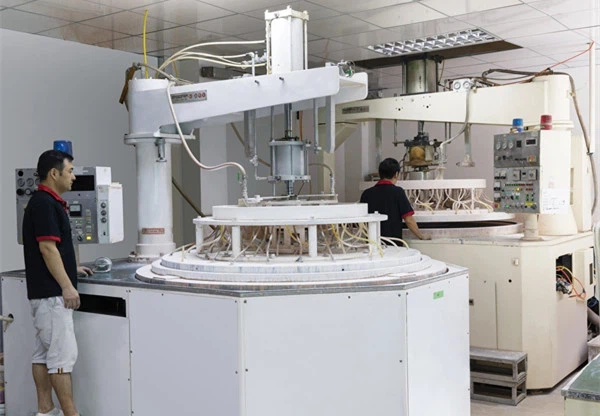
Since 2010, Visions Plus has been a company engaged in machine vision accessories service. With the rapid development of industry 4.0 and the machine vision industry, the requirements for visual accuracy in image detection applications are becoming higher and higher, as are the requirements for the adjustment of internal parameters of cameras and lenses, and the requirements for the high-precision calibration targets. Therefore, in order to better serve customers, at 2017 we have launched high-precision, high-quality, Camera calibration targets, with reasonable prices, and are specially customized for various computer vision applications, serving the positioning, measurement, detection image systems, and applications in machine vision cameras, industrial lenses, industrial automation, visual algorithms, precision research, precision equipment manufacturing, vision systems, Autopilot cars, visual display, precision image transmission and other photo industries.
We have both our own factories and trade services. Our calibration target products include: resolution calibration targets, distortion calibaration targets, Halcon calibration targets, OpenCV calibration targets, USAF1951 resolution targets, dot calibration targets, depth of field ruler, halcon12 calibration targets, checkerboard calibration targets, Ronchi rules, retires, etc.
There are hundreds of standard camera calibration targets/plates/charts, and thousands of custom camera calibration targets/plates/charts.




Certificate

Video
